

Where Are We, And What Are We Doing Here?
A treatise on restaurant design.

Late last year, a chapter of the International Interior Design Association asked me to give a keynote at their annual meeting. If this is surprising to you, trust that it was also surprising to me. Nothing about me is well designed—especially not my interior.
But I wrote a speech about restaurant design and regionality, two topics I’m passionate about, and I had great fun delivering it while weaving from side to side like a particularly pliant cobra. The designers fed me a nice plate of pasta, paid me well, and didn’t complain when I stole a very nice candle intended for their members on my way out the door (scent: “Tobacco Sage”).
I thought I might never hear from them again, but last month, they asked me to give the same speech again for a group in Wichita.
So today, I am sharing it with you! If you have ever wondered what makes a restaurant feel “local” or how much we should all be worried about Ozempic (a medium amount), this talk is for you. It was designed to orated by a shifty woman with the voice of a wharfman, but I trust you all to hear it with the intended inflection.
Thank you for inviting me despite all the red flags.
Someday, I hope to be able to open a talk by launching immediately into a compelling anecdote, like those motivational speakers with suspiciously youthful hairlines. But I have neither the name recognition nor the hairline for that, so instead I am going to open this keynote with the answer to the question on everyone’s minds right now: “Who am I?”
I am not a designer! Let’s get that out of the way. I’m a food writer. From 2016 until 2023, I was the restaurant critic for The Pitch, an alt-weekly in Kansas City, where I developed a lifelong love for speaking to hostile audiences.
These days, my work is mainly in one of three areas. First, I write my own newsletter, Haterade, where I develop recipes for things very few people would want to eat, like soggy school lunch pizza or thick apple pucker or, yes, haterade. Second, I’m a food writer and recipe developer for outlets like Serious Eats, where I try to make things people actually want to eat. And third, for the last four years, I’ve worked for a food industry nonprofit in a role that keeps me traveling to restaurants all around the Midwest.
Given those qualifications and my chosen career path, you might be surprised to hear that I have long told people that I have “no taste.” At one point, I actually wrote a monthly column titled “Tasteless.”
This is a bold thing to admit to a room full of designers. And I recognize that this quality—tastelessness—would make me a nightmare client. But I think it’s actually a boon for a critic, and maybe for some of you as well. Because when I say I have “no taste” I don’t mean I have bad taste. Having “no taste” means abstracting from personal preferences and evaluating what’s “good” in every category.
I’ve spent most of my career traveling around the region looking for exactly that. I can tell you the best place to get an incredibly brisk and clean martini with Japanese gin and a foraged sea grape garnish, and I can also tell you the best place to get a super tart, poison-green appletini made with industrial gut-rot liqueurs. I couldn’t tell you which I like better. The role of a critic is to look for the best in every genre—steakhouses, izakayas, mid-century diners, taco stands. And that role requires you to try to zoom out from your own biases and preconceptions as much as you can.
I think that lens is transferable and useful in any creative field. I suspect a lot of you have clients that gravitate toward your work because they share and admire your aesthetic. But I also suspect that many of you have been asked to design a space that you wouldn’t personally want to live or work in. So how do you think clearly about what makes something “good” that isn’t to your taste and preferences?
Back when I was writing restaurant reviews, there were two questions that I would ask myself before I sat down to write each review. They’re questions that still guide the way I think about and evaluate restaurants today, and they’re design questions at their core. They are:
What is this restaurant adding to the city?
What is this restaurant trying to be?
The answers to those two questions tell you a lot about how to evaluate a restaurant and whether it’s going to be a success. Let me start with the first.
What is it adding to the city?
So maybe you, the critic, don’t love Sichuan food (I love Sichuan food). But if it’s the first upscale Sichuan restaurant to open in the city, that’s meaningful, and that context matters for how you interact with the restaurant and tell its story.
Alternatively, maybe the restaurant you’re visiting is the 30th “elevated comfort food” spot to open in the past year, and maybe you like the short rib risotto just fine, but it doesn’t feel meaningfully better or different than the short rib risotto on any of those other 30 menus. The answer to “What is this place adding to the city?” might be “Not much.” But you still have to contend with the second question:
What is it trying to be?
You don’t have to think a project is worthwhile to evaluate whether it’s living up to its promise. Every restaurant, even the most utilitarian, has a goal. The Costco food court has a goal. And you don’t want to compare it to something it was never trying to be, like Eleven Madison Park.
So you can ask: What are the expectations of someone who goes to grab lunch at the Costco food court? How does the experience live up to those expectations? Is it better or worse than the fluorescent-lit food courts at other big box stores? You get the idea. (Admittedly, I never reviewed the Costco food court, but I did once review a coffee trailer inside my local Home Depot.)
The point is, regardless of whether you personally think a restaurant should exist, you have to ask, What is it trying to be, and how successful is it at achieving that?
I said earlier that these are design questions at their core. And the reason I think these questions are design questions is that they’re ultimately about differentiation and identity. And design plays an outsized role in signaling both of those.
I also think design is going to become even more important to the restaurant industry as diners are forced to get choosier about where they visit and what they spend. I think that because I’ve seen it happen just over the past two years. A lot of news articles about the industry right now are focusing on rising costs and menu prices, and they point to how price-conscious consumers have become as they deal with the effects of inflation over the past couple of years. People report that they’re dining out less. And everyone’s on Ozempic now, so we might expect them to be eating less when they do.
(This is a side point, but one I find kind of interesting, so permit me a brief digression: Several researchers have tried to quantify how GLP-1 use is changing food consumption. One study estimates that the current level of GLP-1 use corresponds to a $7 billion drop in annual food spending just at quick-service restaurants like fast food joints. Another study projects that a modest uptake in the usage rate could lead to a more than $50 billion drop in total food spending annually.)
These are real trends and considerations, and you might assume, based on our apparent price sensitivity, that a table at the Costco food court is about to become as coveted as a table at 1587 Prime.
But there’s a more subtle shift happening here. The National Restaurant Association (tagline: “Not that NRA”) conducts a broad survey of consumers every year. And in their 2025 state of the industry report, they highlighted that 64 percent of customers at full-service restaurants—that’s anywhere you’d sit down and have a server take your order—say their dining experience is more important than the price of the meal.
The James Beard Foundation conducts their own survey of independent restaurant owners every year, and the results from their 2025 state of the industry report might seem surprising as well. Despite all of the anecdotes about how price-conscious we’ve all become in the face of inflation, restaurants reported a slight increase in performance in 2024 relative to 2023. And they reported that while also reporting a drop in overall traffic.
This is sort of confusing, right? How are some restaurants making more money if they’re serving fewer customers? Well, one, they’re raising their prices. But there’s a limit to how much that can help. The same James Beard Foundation survey suggested that restaurants that dramatically raised their prices (by more than 15 percent) saw their performance fall relative to restaurants with smaller price increases. That suggests diners are willing to absorb some price increases—but at a certain point, we get turned off and turn away.
The second—and to me, more interesting—explanation is that diners are cutting back on the frequency with which they dine out, but maintaining or even increasing the amount they spend when they do.
Official government data, not just survey data, seems to bear this out! Per capita expenditures on food away from home have continued to increase every year since the pandemic. People say they’re cutting back, but at the macro level, it really looks like they’re just becoming more selective. They’re spending more on fewer visits. They don’t want (just) dinner. They want an experience.
I’m talking about consumer trends in a general sense here, but I want to be specific: This is also what I’m looking for! And I use the word “experience” intentionally. A few years ago, it seemed like every restaurant review said something about how “Instagrammable” the decor was. That might have helped get a few people through the door, but it’s not enough to make them stay—or come back. A restaurant is not a mural that you take a photo with and then leave. It’s a space you’re experiencing intimately for maybe two hours. It’s closer to a home than a lot of other commercial spaces, because it’s a space you have to want to inhabit as a diner.
And increasingly, I’m hearing from diners that they want that space to feel rooted in place. I mentioned earlier that I work with an industry nonprofit, and part of my role involves talking to food writers and chefs and diners all over the region about what’s going on in their pocket of the Midwest.
And I’ve noticed a subtle shift in what some of them are looking for. I got on a call with a friend in Minneapolis recently and mentioned a spot I was planning to visit. They said something that’s stuck with me: “It’s a great restaurant. The food is technically perfect. But I feel like this could just as easily be in New York.”
Not long ago, that would have been a compliment. They meant it as a critique.
And I understand that critique, because I’ve dined in some of those restaurants myself while I travel around the region.
A few months ago, I went on a multi-state research road trip to try some new restaurants. In Iowa, I dined at a farm-to-table restaurant using local, seasonal ingredients. There was a chalkboard by the front door with a list of all the local purveyors. There were smooth, camel-colored leather banquettes and cordless brass table lamps and a reclaimed wood bar.
I drove to South Dakota the next day. I ate at a farm-to-table restaurant using local, seasonal ingredients. There was a chalkboard by the bathrooms with a list of all the local purveyors. There were smooth, tawny-colored leather banquettes and cordless brass table lamps and a reclaimed wood bar.
From there, I went to North Dakota. I ate at a New American restaurant using local, seasonal ingredients. There was a chalkboard behind the bar with a list of local purveyors. There were camel-colored banquettes and cordless brass table lamps and a concrete (!) bar.
This is the point I’m belaboring: regional identity and differentiation has to happen in the design, not just the menu. Because in many ways, these were hyper-regional restaurants! Everything I was eating had been sourced 5 or 10 minutes away. And yet, as I sat in my booths at each of those restaurants, sipping tap water out of the same amber-colored Duralex Picardie tumblers, I realized I had no idea where I was.
But I can also tell you a different story about some restaurants I visited on the same trip.
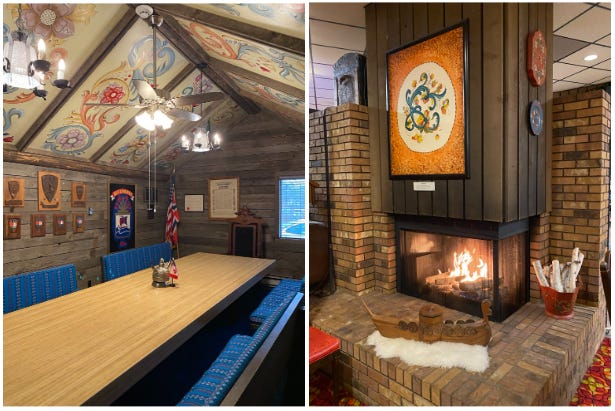
In Fargo, I went to the Sons of Norway Kringen Lodge, a place with deep red carpets and brown brick crackling fireplaces and a dining room with cathedral ceilings made from huge pine beams coated with moody black pine tar that made me feel like I was on board an ancient Nordic ship.
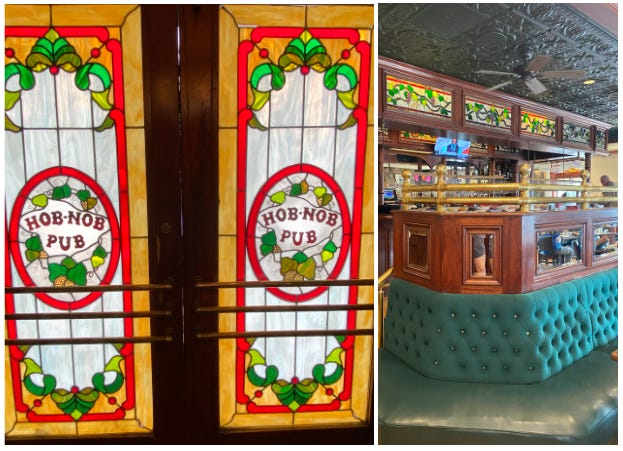
In York, Nebraska (population 8,000), I went to the Chances “R” Restaurant and Hob-Nob Lounge, a 100-year-old fossil record of bottle-green carpets and custom stained-glass windows and etched-glass booth toppers with the silhouettes of wild horses. The bar wasn’t used for drinks. It was there mainly to support a thoroughly Midwestern salad bar that stretched to the next county. I don’t know if any of the ingredients on the salad bar were locally sourced. But I knew exactly where I was. And I couldn’t think of anywhere I’d rather be.
One of the reasons these restaurants are so compelling to me is that they’ve been able to maintain their identity through eras that rewarded a very different approach.
Because while diners may want regional differentiation now, that has not always been the goal of restaurants, even independent ones. I was born in 1989, and my childhood was marked by the rapid proliferation of chain restaurants like Applebee’s and Chili’s and Outback Steakhouse whose whole draw was the consistency of the experience. It didn’t matter whether you were eating your quesadilla burger and chicken wonton tacos in Baltimore or San Jose—you were eating them in the same place.
I think there’s a direct through-line between the placelessness of these Y2K era chains and the design tropes of the 2010s. A lot had changed: maximalism was out, minimalism was in, and while diners had started prioritizing independent coffee shops and restaurants over chains, the overall aesthetic of those independent spots was still familiar and flat. I’m thinking specifically of the third-wave coffee shop / Airbnb aesthetic the writer Kyle Chayka called “AirSpaces” in a widely read 2016 essay.
The appeal of AirSpaces—white wall minimalism, white marble countertops, Scandinavian light-toned wood accents—is a frictionless existence. Homogeneity is the point. You can “drink local” at a coffee shop in San Francisco that looks identical to your neighborhood coffee shop in KC. You can leave home without ever traveling.
I should be clear that I don’t think diners have fully evolved beyond this. In fact, in 2025, Chili’s saw 31 percent growth in sales relative to the previous year. Minimalism is out, maximalism and nostalgia is in. But I do think there’s something more interesting happening than just the usual endless seesaw of trend and counter-trend.
As our lives become more digital and depersonalized, I think there’s a growing hunger for spaces that feel specific and soulful and grounded. I definitely feel it. I walked into the Snack Shack a couple weeks ago—a casual burger spot in the KC metro that I’ve been to a dozen times, with an aesthetic that feels perfectly authentic to what it is—and I saw these AI-generated advertisements all over the doors. It’s a recognizable aesthetic, AI art: it tends to be grim and alien. The colors are always strangely dark and muted, like you’re looking at a picture through a tinted window. And staring at these posters, I felt something like a taste preference forming for the first time: I hated this. I was repelled by it.
I recognize that this is getting a little abstract and touchy-feely. I’m really talking about restaurants’ souls. But that’s where the second question comes in: what is this place trying to be? It’s a question of identity, but it’s also a question about soul.
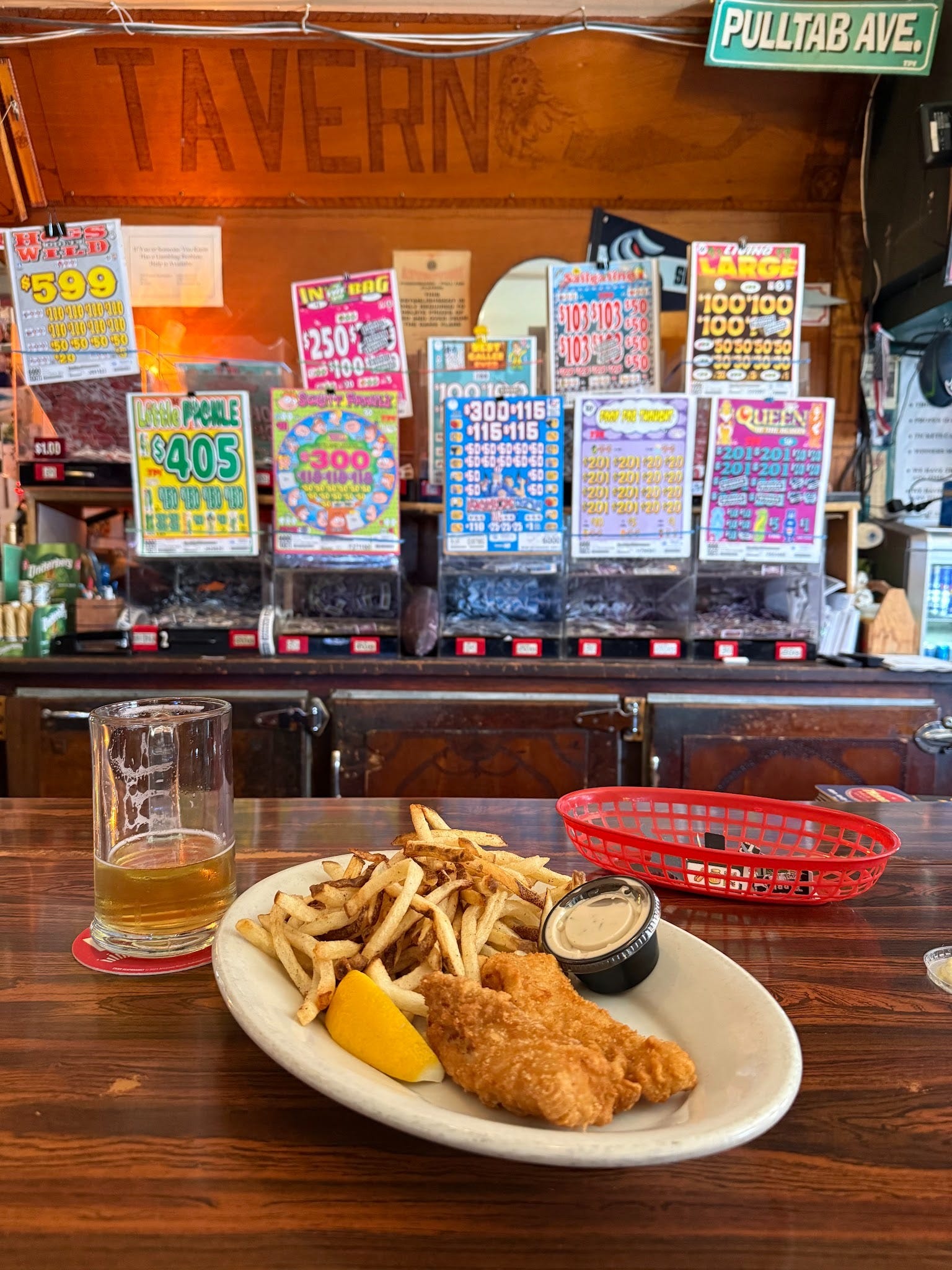
And that is something that you tend to feel in a space more than you see it. Let me give you an example in a tale of two restaurants: a TGI Fridays, circa 1995, and The Sloop Tavern, a 1953 Seattle dive bar and no-fee “yacht club” back when that meant something very different.
If you just just looked at a tiny 2x1 Instagram photo of these spaces, you might conclude they have a similar vibe. But there’s a difference between the random trophies and pennants from non-existent sports teams hanging on the walls of a TGI Fridays and the case of sailing trophies and plaques earned by regulars of The Sloop Tavern. The first one is an empty aesthetic. The second one is an identity—a story. The Sloop has a clear connection to and purpose for the artifacts in its space. I can attest that it feels completely different to inhabit those two restaurants, and there’s only one I want to go back to.
The concepts of identity and authenticity and storytelling can be hard to wrap your arms around. So I want to keep this in the realm of the concrete by talking through a specific space, and a specific design and designer. While I was preparing for this talk, I called up my friend Brian Miller. Brian lives and works in DC, and he’s my polar opposite in one very important respect: Brian has taste.
Brian is also an interior architect whose passion is restaurant architecture and design. He’s responsible for some of DC’s most iconic restaurant interiors, including the Michelin-starred (and, I would argue, quite regional) restaurant The Dabney and the Michelin Guide–recommended sandwich shop Your Only Friend.
When I talked Brian through my two questions—What is this space adding to the city, and what is it trying to be?—he didn’t need me to explain them. He doesn’t ask his clients those questions, per se, but they’re implicit in the work. With Your Only Friend in particular, “What is this place trying to be?” needed to be answered in an explicit and upfront way through the design of the space. Because Your Only Friend is not a pleasant farm-to-table restaurant with mason jar vases and a chalkboard menu. Your Only Friend is a super weird, playful sandwich shop with Cool Ranch Dorito flavored onion rings and a plate-sized chicken nugget and nerdy, meticulously built cocktails inspired by Orange Juliuses and Dole Whips.
He said:
For us, it was about creating a design where, first of all, somebody intuitively knew what it was. I always use the example of seeing an older couple approach a place with some trepidation—like, come in, sit down, get handed menus, read over the menu, then look at each other and, without saying anything, get up and leave. That’s a failure of design to set an expectation.
Approachability was an important theme for the space, and one of the ways he helped set diners expectations was with an enormous stained glass ceiling with a bottle of Duke’s mayonnaise at the center, like a saint. I’ve been in that space and can confirm that that stained glass felt just right for the restaurant’s menu and focus. But there was something about it that also felt distinctly regional to me…and distinctly Midwestern.
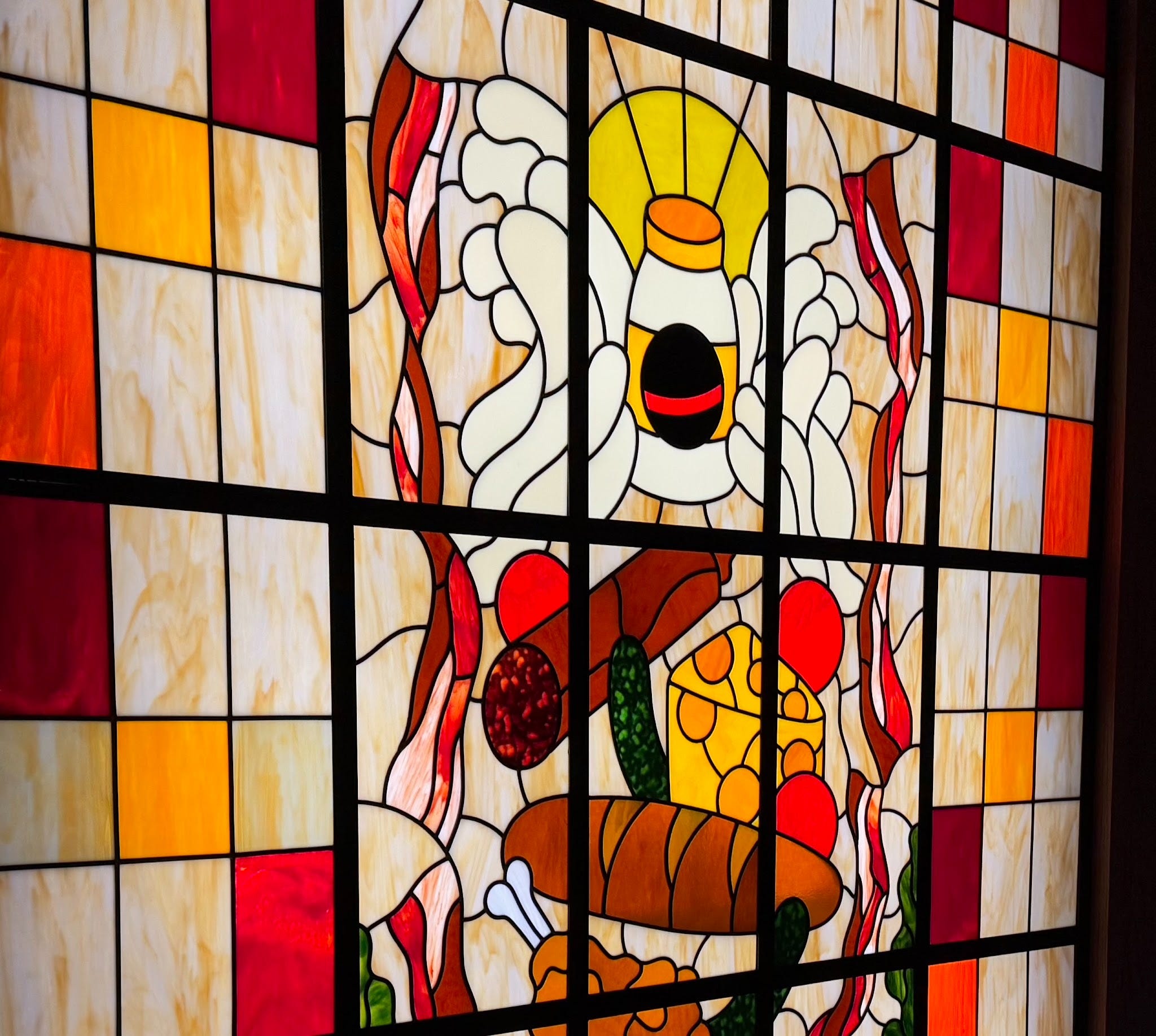
Brian confirmed when we talked that it was an homage to a sort of Midwestern community restaurant. I felt vindicated, but I also felt a little panicked. This was a restaurant in DC, not York, NE. It seemed to undermine my flimsily constructed thesis about regional differentiation and rootedness.
But when I looked into the restaurant a little more, I realized the stained glass wasn’t an exception. Instead, it seemed right at the intersection of differentiation and identity. Because the nod to the Midwest wasn’t random. One of the co-owners got her start working in restaurants outside of Detroit and cut her teeth in the Chicago restaurant scene before moving to DC. Whether you know that background or not, it helps inform the restaurant’s story and visual aesthetic. If you care about place, you could call it picture-in-picture: a kind of micro-regionalism that both differentiated the space and helped define what it was trying to do.
Brian put it in slightly different terms:
I think moreso, a micro-regionalism has given way to a sort of micro-personalism, where people’s individual stories about who they are and how they see the world is what they want their restaurants to reflect. Think of somebody who’s like, “My parents are Mexican, but I was raised in Texas, and now I’m living in Maryland, and this is what I want my restaurant to reflect. And I want the space and menu to make sense with that story.”
So maybe we’re in an era of micro-personalism now. I’m willing to concede the point. But it’s notable to me that his example—the second-gen Mexican immigrant raised in Texas and living in Maryland—now has to reflect a connection to three places instead of one.
No one’s obligated to be a regional designer. No one’s obligated to operate a regional restaurant. But every restaurant has a story to tell. And the one thing all stories have in common is that they have to take place somewhere.
Haterade is a free newsletter sustained by cordless table lamp enthusiasts like you. The best way to support the newsletter is to share it and talk about it! If you’d like to help fund the Liz Cook Rehabilitation Center for Candle-Stealers, become a paid subscriber (no perks; perfect vibes) or stuff some money in the tip jar here: Venmo | PayPal.
Admittedly, I'm not quite sure how I feel about this piece, other than I admire it and will think about it the next time I enter a restaurant - and wish that most restaurants thought as much about their design as the author did about her topic. As I now will. Thanks -
This has filled me with a surprisingly large amount of dread.
Someone who wants to open a restaurant asking Ai, "how do I give my restaurant a soul?" "What is the best soul?" "How to be authentic?"